Manufacturing assembly lines rely on predictable material flow. When lifting equipment is added without careful planning, it can slow takt time instead of improving it. The right lifting solution should therefore support the sequence of work, reduce operator strain, and maintain product quality without creating unnecessary interruptions. In this environment, compact and repeatable lifting tools are often more valuable than oversized high-capacity equipment.
One of the main objectives is ergonomic positioning. Operators frequently need to align motors, frames, enclosures, tooling, or semi-finished parts at a consistent working height. If this is done manually, fatigue rises quickly and accuracy suffers. Manual handling lifts, compact gantries, and fixed scissor platforms can all help by bringing parts into the correct position for assembly instead of forcing the workforce to adapt to awkward load height.
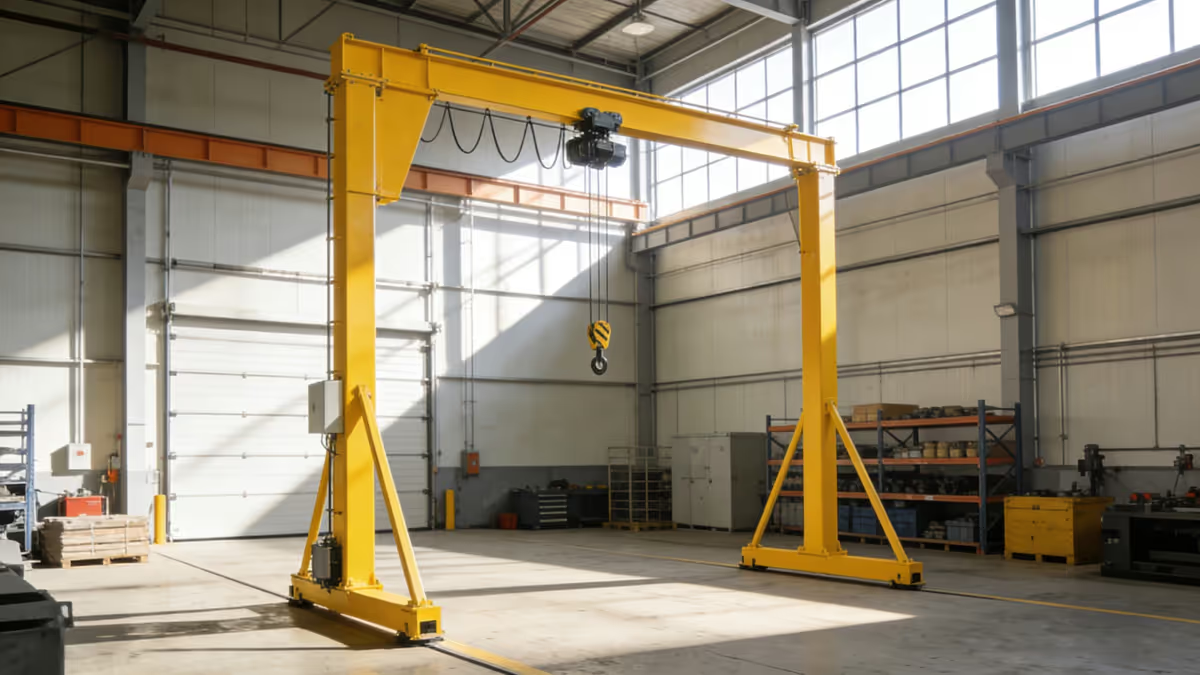
Another priority is line continuity. Assembly environments cannot tolerate random obstruction. Lifting devices must be sized to fit station layout, aisle width, and product flow. Portable gantries are valuable for maintenance or changeover tasks, while smaller material lifts support repetitive component positioning. Where upper-level access is needed for conveyor, pipe, or cable support work, electric scissor lifts provide a more controlled and safer method than ladders or improvised platforms.
The third consideration is process accuracy. Sensitive manufactured products may require soft handling, low vibration, and exact positioning. This matters in electronics, machinery assembly, packaging systems, precision modules, and export-oriented production where cosmetic or alignment defects are costly. A properly selected lift solution reduces impact loads and improves installation consistency.
Ascent Crane typically recommends a station-based lifting design for assembly lines: compact manual or hydraulic lifts for repetitive positioning, portable gantry cranes for maintenance and tooling changes, and access platforms for overhead service work. The ideal configuration depends on part weight, cycle frequency, workstation spacing, target output, and whether the line must remain live during service interventions.