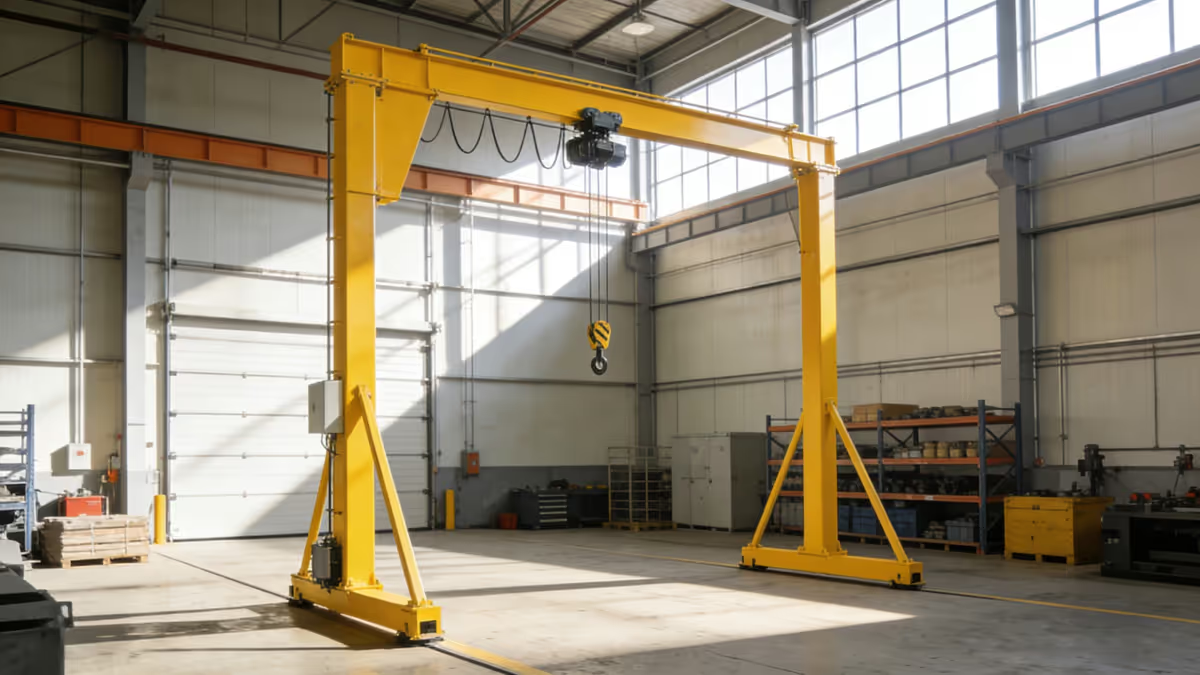
How to Choose the Right Span and Height for a Micro Gantry Crane
Choosing a micro gantry crane is not only about load capacity. In many real projects, the more important buying question is whether the crane geometry actually fits the job. A gantry that is too wide becomes difficult to move in narrow aisles. A gantry that is too low cannot provide enough hook travel. A gantry that is too tall may create stability concerns or become impossible to pass through doors, mezzanines, or workshop service areas.
That is why experienced industrial buyers focus on two dimensions before they ask for a formal quotation: span and height. These values determine whether the crane can straddle the load, whether the hook can reach the lifting point, and whether the frame remains practical inside the real operating environment.
In this guide, I will explain how to choose the correct span and height for a micro gantry crane, what measurements you should collect from site conditions, and how to avoid the common mismatch between catalogue dimensions and real workshop use.
Understand the Difference Between Span, Overall Width, and Usable Space
Many buyers use the word span loosely, but in gantry selection the exact dimension matters.
What span normally means
In most portable gantry discussions, span refers to the clear horizontal distance between the supporting legs or the effective beam distance that allows the load to sit beneath the frame.
However, buyers should also separate span from:
- Overall frame width
- Inner clear width between legs
- Wheel-to-wheel outside dimension
- Beam overhang at the ends
If you only ask for “a 3 meter gantry,” the supplier may not know whether you mean beam length, inner width, or total frame width.
Why this matters in purchasing
A gantry can look correct on paper yet fail in use because:
- The load cannot fit between the legs
- The wheel base is too wide for the aisle
- The frame cannot pass through a doorway
- The trolley cannot reach the desired pick point near the beam end
For that reason, site measurement should come before model selection.
Start With the Load Envelope, Not the Crane Catalogue
The right span is usually determined by the object you need to lift and the path around it.
Measure the load envelope
You should measure:
- Maximum load width
- Maximum load length
- Pick-up point location
- Whether the load must remain centered or may be offset temporarily
- Required clearance on both sides for sling angle, handling, or operator access
For example, if a machine component is 1.8 meters wide, an inner clear width of 1.9 meters is usually not practical. You need side clearance for safe positioning, not just theoretical fit.
Allow operating clearance
A good commercial rule is to add practical side clearance for:
- Positioning error
- Hook approach angle
- Sling movement
- Hand clearance
- Minor load swing control
This is one reason buyers should avoid selecting the smallest possible span just to reduce price.
Choose Span Based on Application Scenario
Different workshops need different span priorities.
Narrow maintenance areas
If the crane is used in maintenance cells, service corridors, or machine repair zones, compact width may be more important than maximizing coverage. In these cases, buyers often prefer a shorter span and reposition the gantry more often.
Warehouse and material handling areas
In larger open areas, a wider span can help straddle pallets, tables, racks, or machine bases. But wider span also increases beam stress and deflection, so the structure must be sized correctly.
Assembly and mold handling
If the gantry must serve several stations, span should match the widest realistic station layout instead of only the current product size.
Understand Height Terms Before Ordering
Height is another dimension that buyers often describe too generally.
Key height values to confirm
For a micro gantry crane, you should distinguish between:
- Overall crane height
- Adjustable leg height range
- Beam height from floor
- Hook height at top position
- Effective lifting height below the hook
- Required headroom for hoist and trolley
A common error is asking for “3 meters lifting height” when the real requirement is 3 meters of hook travel under the beam. Those are not the same thing.
Hoist headroom matters
Even if the beam is high enough, the hoist body and trolley assembly consume space. This means available hook height is always less than beam height. Overseas buyers should always ask suppliers to provide loaded hook dimensions, not only frame height.
Determine Required Hook Height From the Real Lift Path
The correct way to choose height is to define the lift path from the pickup position to the highest required placement position.
Measurements to collect
You should record:
- Lowest hook position needed
- Highest set-down or installation point
- Load height itself
- Rigging height
- Hook block height
- Safety clearance above the final placement point
Practical example
Suppose you need to lift a machine part onto a 1.6 meter platform. The part itself is 0.8 meter high. The slings and hook assembly consume 0.4 meter. You also want at least 0.2 meter working clearance.
Required lower-hook height at top position becomes roughly:
1.6 + 0.8 + 0.4 + 0.2 = 3.0 meters
Now you must still confirm whether the hoist, trolley, and beam arrangement can provide that hook height in the chosen frame configuration.
Check Building Constraints Before Selecting a Tall Frame
Taller is not always better. A higher gantry may reduce portability, increase sway sensitivity, and create transport problems.
Site restrictions to verify
Buyers should inspect:
- Door height
- Roller shutter opening height
- Beam or pipe obstruction
- Lighting fixtures
- Sprinkler lines
- Mezzanine underside clearance
- Forklift crossing points
If the gantry needs to move between rooms, the transport height may matter more than the working height. In that case, an adjustable-height frame is usually more practical.
Balance Height With Stability and Mobility
A portable gantry crane should not be selected only by maximum reach. Stability becomes more sensitive as the frame gets taller.
Why tall frames need extra caution
Higher height can increase:
- Frame flexibility
- Lateral sway during movement
- Sensitivity to uneven floors
- Difficulty in positioning heavy loads accurately
This does not mean tall gantries are unsafe by definition. It means the buyer should ask whether the rated load changes with height position and whether the crane may travel under full load.
Questions to Send to the Supplier
If you want accurate recommendations, send these details in your inquiry:
For span
- Maximum load width
- Required inner clearance
- Aisle width and door width
- Whether the gantry must pass around existing equipment
For height
- Highest hook position required
- Load height and rigging height
- Building height restrictions
- Whether adjustable height is needed
For operating method
- Manual or electric hoist
- Stationary lifting or travel under load
- Floor condition
- Duty frequency
Common Selection Mistakes
Choosing by beam length alone
Beam length does not tell you the real inner working width.
Ignoring hook headroom loss
A tall beam does not automatically give the hook height you need.
Forgetting travel path restrictions
A gantry that fits the lift zone may still fail to pass through the route between stations.
Buying too close to the minimum size
If your application changes later, the crane may become a bottleneck very quickly.
Final Recommendation for Overseas Buyers
To choose the correct span and height for a micro gantry crane, start from the load path and the site layout, not from a standard catalogue model. Measure the real load envelope, the required hook travel, and the building restrictions. Then ask the manufacturer to confirm rated load, deflection, and travel limits at that exact size.
When buyers provide full dimensional data early, suppliers can recommend a frame that is easier to use, safer in practice, and less likely to cause installation or handling problems after delivery.
Related Products
If you are comparing portable lifting solutions for confined workshop use, you may also review these product pages: